
Data Center Corrosion Testing
Assess corrosive environmental conditions that can affect sensitive data centre hardware. Identify potential risks from gaseous contaminants and other relevant environmental factors through a testing scope tailored to your facility.
What is data center corrosion testing?
Data center corrosion testing is non-intrusive mixed flowing gas (MFG) monitoring that tracks the corrosive gases, humidity and airborne particulates building up in a server environment. Corrosive gases like hydrogen sulfide, sulfur and nitrogen oxides, and chlorine build up slowly and attack circuit boards and connectors long before any alarm goes off. By the time hardware visibly fails, the corrosion has usually been progressing for months, and the resulting downtime costs far more than the monitoring would have.
Equinox Labs runs non-intrusive MFG monitoring for data centres, tracking corrosive gases, humidity, moisture and particulate and gaseous indoor pollutants without disrupting live server operations. Testing is carried out at NABL-accredited (ISO/IEC 17025) laboratories, trusted by 95,000+ clients, giving you an early warning before equipment failure or a compliance audit. It's one part of our broader environmental testing services, often paired with indoor air quality testing.
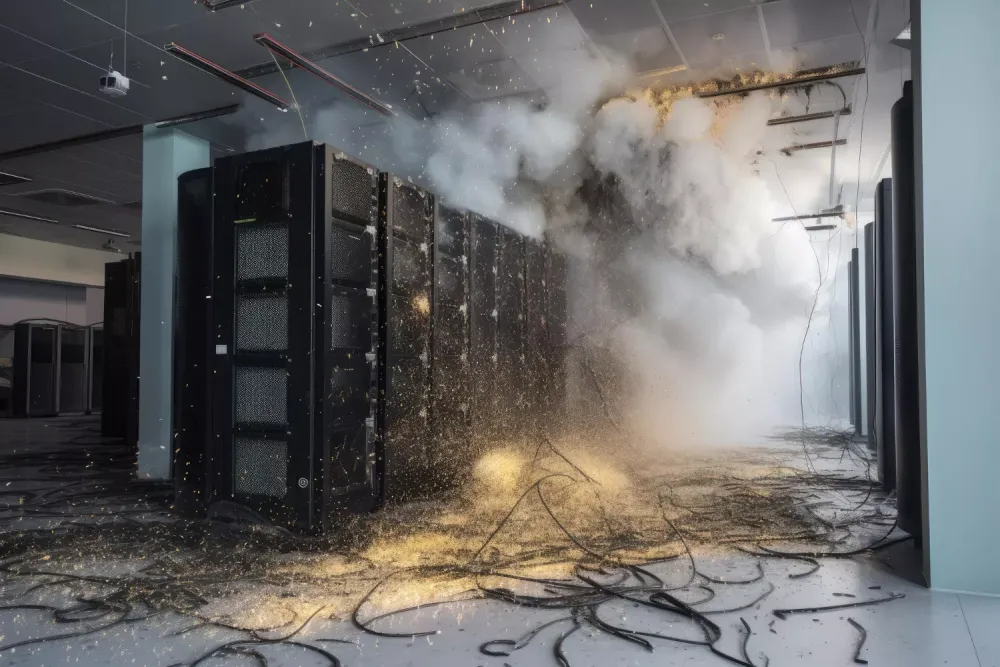
What unchecked corrosion actually costs you
Corrosive gases, particulate contamination and unsuitable environmental conditions can contribute to the deterioration of sensitive electronic components. The resulting damage may affect equipment reliability and increase maintenance requirements.
- Unplanned Downtime. System failures that take critical infrastructure offline without warning.
- Equipment Degradation. Accelerated component failure across circuit boards and connectors.
- Data Loss. Compromised hardware puts the data it holds directly at risk.
- Elevated Costs. Higher maintenance and hardware replacement spend as corrosion compounds.
- Reduced Efficiency. Degraded connections and components drag down energy efficiency and performance.
Monitoring built for live server environments
Non-intrusive assessment of both the corrosive load and the conditions that drive it.
Corrosive Gas Monitoring
Hydrogen sulfide, sulfur and nitrogen oxides, and chlorine tracked at server-room concentrations.
Airborne Particulate & Ozone Testing
Particulate and gaseous indoor pollutants measured alongside ozone concentration.
Humidity & Moisture Assessment
Relative humidity and moisture levels tracked as key drivers of accelerated corrosion.
Non-Intrusive On-Site Sampling
Field monitoring conducted without disrupting live server operations or uptime.
Real-Time Air Quality Monitoring
Continuous readings that flag a rising corrosion risk long before the next scheduled visit.
Infrastructure Validation Before Deployments
Pre-deployment air quality sign-off so new racks and hardware go live in a validated environment.
Parameters we monitor
The gas and environmental parameter set used for corrosion risk classification.
Corrosive Gases
Environmental Conditions
Built for uptime-critical infrastructure
From colocation providers to enterprise IT teams.
Data Centre Operators & Colocation Facilities
Recurring corrosion classification to protect hosted server hardware.
Enterprises With On-Premise Server Rooms
Corrosion monitoring for in-house IT infrastructure outside a dedicated data centre.
IT & Infrastructure Teams Needing Audit Documentation
Compliance records to support internal audits and infrastructure sign-off before deployments.
Cloud & Managed Service Providers
SLA-backed uptime commitments that depend on hardware staying corrosion-free.
Financial Institutions & BFSI Data Halls
High-compliance environments where hardware failure risk carries outsized consequences.
Telecom & Network Operations Centres
Always-on network infrastructure where unplanned downtime has a direct customer impact.
How to prevent corrosion in your data center
Testing catches the problem. These five habits keep it from starting in the first place.
- Routine Corrosion Testing. Scheduled MFG monitoring, not just a one-off check after a failure.
- Indoor Air Quality Monitoring. Continuous tracking of the pollutants that drive corrosion.
- Humidity Control & Filtration. Keeping relative humidity and particulates within safe bounds.
- Quarterly Facility Audits. Regular structural and environmental reviews, not annual spot checks.
- Staff Training. On-site teams trained to recognise early corrosion warning signs.
3 Factors That Can Cripple Your Data Center
Data centers face operational risks that quietly build over time. This guide breaks down how cost decisions, aging UPS systems, and unnoticed pollutants can cripple reliability if left unchecked.
- Cost Decisions vs. Reliability: how short-term cost decisions undermine long-term reliability
- Aging UPS Systems: why outdated UPS systems drain efficiency and increase losses
- Pollutant-Driven Corrosion: how unnoticed pollutants accelerate equipment corrosion and failure
- Power Audits: why routine power audits prevent overloads and unexpected shutdowns
 Free Guide
3 Factors That Can Cripple Your Data Center
Learn how cost decisions, aging UPS systems and unnoticed pollutants can cripple reliability if left unchecked. Download the free guide.
Download Your Free GuideThe air risk inside your facility
 Video
Is Your Office Air Making You Sick? The Truth About Corporate IAQ
- How airborne contaminants build up in enclosed, tightly controlled spaces
- Why corrosive gases and particulates threaten sensitive equipment and people
- What continuous monitoring reveals that a one-off check misses
Sample to certified report, in four steps
The same process across every data centre corrosion engagement.
Inquire
Tell us your facility size and how many zones need monitoring.
Non-Intrusive Monitoring
Our engineers deploy monitoring equipment without disrupting live server operations.
Lab Analysis
Readings are analysed at our NABL-accredited labs to classify corrosion risk.
Results & Support
We email your certified report and advise on any corrective action needed.
Access the Equinox PortalWhy Choose Equinox Labs for Data Center Corrosion Testing?
Accredited methodology, non-intrusive field work, and a team that reads the numbers with you.
NABL Accredited
ISO/IEC 17025 accredited testing means your reports are defensible for any audit.
Non-Intrusive Methodology
Monitoring runs alongside live operations with zero disruption to hosted hardware.
Pan-India Field Teams
Calibrated monitoring equipment deployed across 500+ cities, trusted by 95,000+ clients.
A Dedicated Account Manager
One point of contact who tracks your monitoring calendar across every facility.
Data Center Corrosion Testing FAQs
Data center corrosion testing assesses environmental conditions that may contribute to corrosion of sensitive electronic equipment. Depending on the method and agreed scope, this may involve corrosion-rate assessment, gaseous contaminant monitoring, particulate assessment or measurement of relevant environmental conditions.
Testing frequency depends on the assessment method, facility conditions, monitoring objectives and applicable technical guidance. A periodic monitoring programme may be appropriate, but the recommended interval should be selected for the specific facility and method.
The parameters depend on the testing scope. An assessment may include selected corrosive gases, particulate contamination, temperature and relative humidity. Where coupon-based corrosion testing is used, the analysis can assess corrosion rates on the selected test materials.
Corrosive contamination can contribute to deterioration of circuit boards, connectors and other sensitive electronic components. Monitoring environmental conditions can help operators assess potential risks and determine whether further investigation or corrective measures may be appropriate.
The service can be planned to minimise disruption, depending on the monitoring method and site requirements. Confirm the equipment placement, access arrangements and any operational considerations with the service team before scheduling.
Potential contributors include corrosive gaseous contaminants, particulate contamination and environmental conditions that influence corrosion. The relevant factors depend on the facility, contamination sources, airflow and environmental controls.
Corrosion risk management may include appropriate testing, contamination control, filtration, humidity management, routine maintenance and follow-up actions based on assessment results. The suitable measures depend on the conditions identified and the facility's equipment requirements.
The timeline depends on the selected method and monitoring duration. We confirm the expected completion time, including any required exposure period, laboratory analysis and reporting, before the service is scheduled.
The price depends on factors such as the testing method, parameters, number of monitoring locations, monitoring duration and facility location. Share your requirements with Equinox Labs to request a quotation.
Get your Data Center Corrosion Testing enquiry answered
Tell us a little about your requirement and our team will get back to you within one working day.
- Response within one working day
- PAN-India service network
- Dedicated account manager
Thanks, we've got your enquiry
Our team will reach out within one working day to discuss your requirement.